


Table of Contents
Sharing:


Little BIM/Big BIM – Open BIM/Closed BIM
If you deal with the planning method Building Information Modeling (BIM), sooner or later you will inevitably come across the terms Little BIM, Big BIM, Open BIM and Closed BIM. We explain what these technical terms are all about.

What is Little BIM and Big BIM?
The digital working method Building Information Modeling (BIM) can initially be divided into Little BIM and Big BIM.
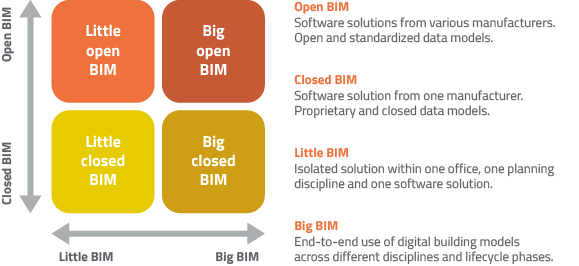
- Little BIM: The technique describes the limited application as an isolated solution within an office or construction company as well as a planning discipline. Mostly, the software of only one manufacturer is used here.
- Big BIM: This variant refers to the continuous use of digital building models across different trades and lifecycle phases.
What is Open BIM and Closed BIM?
In terms of software, BIM can be further divided into Open BIM and Closed BIM.
- Open BIM: Data is exchanged via various software solutions and open, standardized data models. For the exchange of BIM data, the IFC format (Industry Foundation Classes) is the leading international standard. Open BIM offers the advantage that all project participants can choose the software that is best suited to their own work processes.
- Closed BIM: Data exchange takes place via a uniform program. These are proprietary, closed data models. All planning participants work simultaneously in one building model. Closed BIM enables the uncomplicated coordination of specialist models. By using an identical file format for planning, information losses due to misinterpreted data can be largely excluded.
What are the BIM Variants?
There are four different ways to use BIM:
- Little Closed BIM: The user works on a digital model in his own discipline. He uses one software and does not share his data with other disciplines.
- Big Closed BIM: Planning participants from different trades deal with a digital model. A common program is used to handle the various disciplines, with data exchange taking place via a proprietary interface.
- Little Open BIM: The user works on a digital model in his department by means of a single software. Data exchange takes place via a closed and an open interface.
- Big Open BIM: This variant is the largest possible BIM method. Users from a wide range of disciplines work together on the digital model. Different software solutions are used and data exchange takes place via neutral interfaces.
Conclusion
The BIM planning method makes it possible to work in different variants, each with its own advantages. Open BIM offers users more flexibility, whereas with Closed BIM the interfaces are manageable. Which working method is the right one depends on the type of collaboration and must be determined before the project starts.


