


Augmented Reality - definition and function

How is Augmented Reality defined?
Although the term augmented reality (AR) was not coined until the 1990s, the roots of this technology go back to the late 1960s. In 1968, Ivan Sutherland and his student Bob Sproull invented the first virtual reality headset, "Sword of Damocles," through which geometric patterns were placed in the user's field of view. In the meantime, the definition by Ronald T. Azuma from 1997 has become accepted: „Augmented Reality (AR) is a variation of Virtual Environments (VE), or Virtual Reality (VR) as it is more commonly called. VE technologies completely immerse a user inside a synthetic environment. While immersed, the user cannot see the real world around him. In contrast, AR allows the user to see the real world, with virtual objects superimposed upon or composited with the real world. Therefore, AR supplements reality, rather than completely replacing it.“ - Azuma, R. T. (1997). A Survey of Augmented Reality.
This means AR enables the direct and seamless integration of virtual objects into our real environment.
How does Augmented Reality work?
Augmented reality superimposes digital content onto the real world in real-time. Using cameras or sensors, the AR device captures the user's physical environment. The software analyzes this data to determine position and orientation. Using this information, the system adds computer-generated images or information to the live view. The result is shown on the device's display, combining physical and digital elements.
3Dfindit and Augmented Reality
With the new update, it is now possible to convert components into AR objects on 3Dfindit. This will be explained below using an example component, a bench from the company Nusser. After entering the bench in the search bar, a QR code is generated by clicking on the AR icon. The user can now download the code, copy the link or scan it directly with the smartphone. If the device supports augmented reality, the selected part is displayed on the device's screen and seamlessly inserted into the real environment captured by the camera. Finger gestures can be used to zoom in, zoom out and rotate the bench. In this way, the user gets a picture of what the object looks like in reality at the desired location.
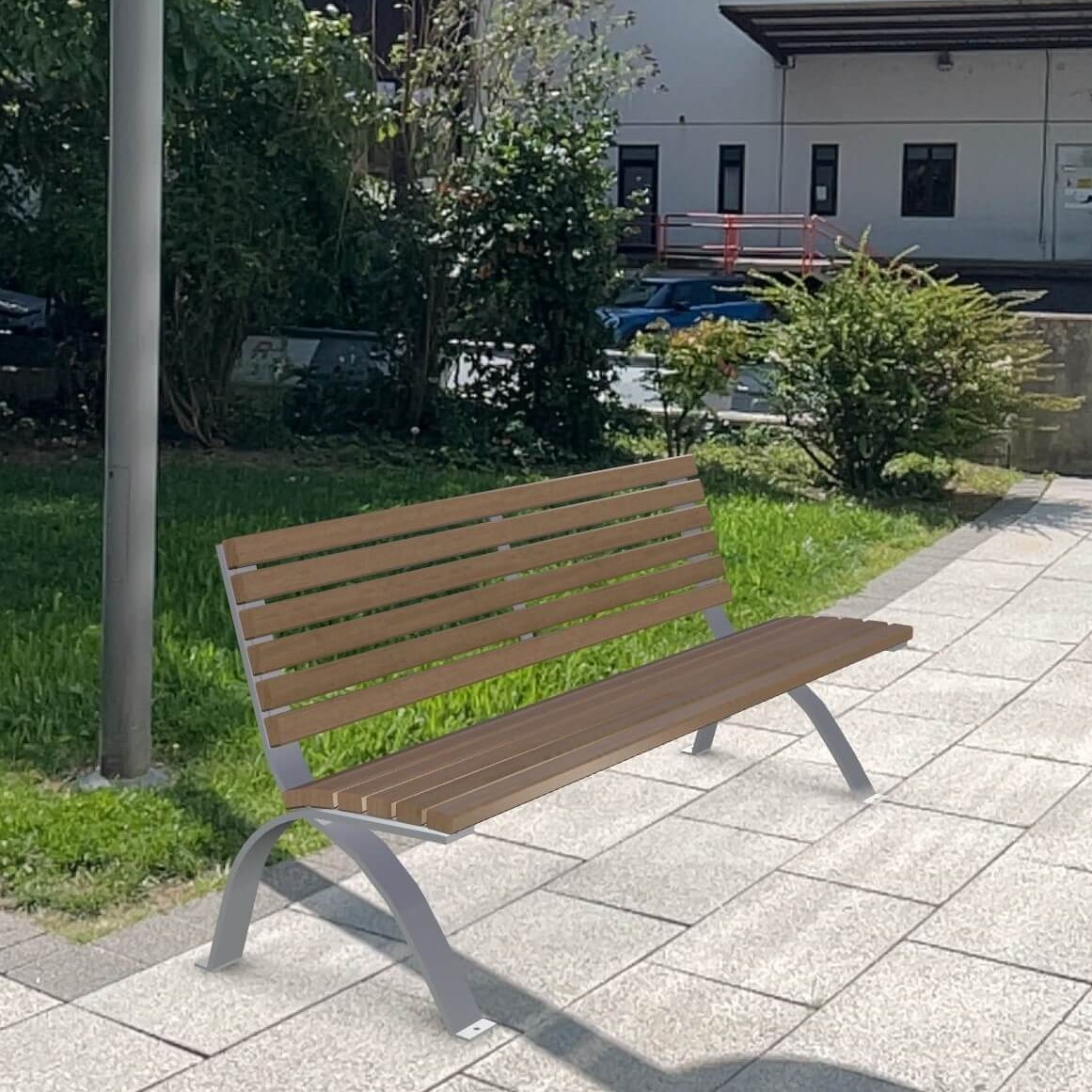
AR-generated bench in park
How and for what is AR used?
AR has many uses and is applied in numerous industries.
In construction, architects and planners can display a digital model of a planned structure directly on the building site. In parallel, it is invaluable in medicine, providing the operating doctor with detailed insight into organs. In everyday life, AR is encountered in the form of head-up displays in cars, for example, which make navigation much easier. In addition, with the help of AR software, it is possible to virtually place pieces of furniture in homes and view them in a hologram-like display. AR is even proving helpful in scientific fields, such as geology. It has also found a variety of applications in Industry 4.0, such as maintenance, repairs, quality control, and training, among others.
Difference to VR and XR
The differences between these technologies lie in the way they integrate virtual content with the real world. In Virtual Reality (VR), a completely new 360° virtual environment is generated, and the real world is completely replaced by a computer-generated one. Extended Reality (XR), on the other hand, is an umbrella term for all types of virtual and augmented reality technologies. XR does not completely replace reality but enhances and extends perception with virtual elements and environments. So, in summary, VR puts the user in another world, AR adds digital elements to the real world, and XR is the superordinate term for all technologies that change the perception of reality in one way or another.
Conclusion
Augmented reality is a technology that blends digital information into the real world. The possible applications of AR are broad and range from the construction industry to medicine and everyday applications. In many areas, this gives us an insight into how the desired components, shoes, houses, pieces of furniture and much more can later look in real life.
